
Albert Einstein
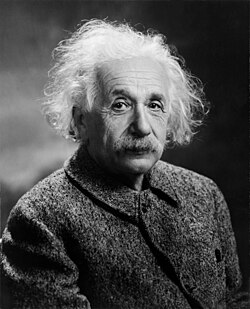
Image from Wikipedia
Author: Photograph by Oren Jack Turner, Princeton, N.J. Original image cleaned/leveled by User:Jaakobou. | License: Public domain
Biography
Early Life and Education
Albert Einstein was born on March 14, 1879, in Ulm, in the Kingdom of Württemberg in the German Empire. His parents were Hermann Einstein, a salesman and engineer, and Pauline Koch. In 1880, the family moved to Munich, where Einstein's father and his uncle Jakob founded Elektrotechnische Fabrik J. Einstein & Cie, a company that manufactured electrical equipment.
Einstein showed an early fascination with science and mathematics. At age five, his father showed him a pocket compass, and Einstein realized that something in "empty" space acted upon the needle; he later described the experience as one of the most revelatory moments of his life.
The Miracle Year (1905)
In 1905, while working as a patent clerk in Bern, Switzerland, Einstein published four groundbreaking papers in the scientific journal Annalen der Physik. This period is often referred to as his "Annus Mirabilis" or miracle year:
- Photoelectric Effect: Explained how light could be understood as particles (photons), for which he later won the Nobel Prize in Physics in 1921.
- Brownian Motion: Provided empirical evidence for the existence of atoms.
- Special Relativity: Introduced the famous equation E=mc², showing the relationship between mass and energy.
- Mass-Energy Equivalence: Demonstrated that mass and energy are interchangeable.
General Theory of Relativity
In 1915, Einstein completed his General Theory of Relativity, which revolutionized our understanding of gravity. Rather than viewing gravity as a force, Einstein described it as a curvature of spacetime caused by mass and energy. This theory predicted phenomena such as the bending of light by gravity and the existence of black holes, which were later confirmed through observation.
Later Life and Legacy
Einstein emigrated to the United States in 1933 to escape the rise of Nazi Germany. He accepted a position at the Institute for Advanced Study in Princeton, New Jersey, where he remained for the rest of his life. During World War II, he was instrumental in alerting President Franklin D. Roosevelt to the potential for Nazi Germany to develop atomic weapons, though he later became a passionate advocate for nuclear disarmament and world peace.
Einstein passed away on April 18, 1955, in Princeton. His contributions to physics fundamentally changed our understanding of the universe, from the smallest particles to the largest cosmic structures. He remains one of the most influential scientists in human history, and his name has become synonymous with genius.
"Imagination is more important than knowledge. For knowledge is limited, whereas imagination embraces the entire world, stimulating progress, giving birth to evolution." — Albert Einstein
Awards & Honors
- Great Immigrants Award (2009)
- New Jersey Hall of Fame (2008)
- honorary doctor of the Hebrew University of Jerusalem (1949)
- Member of the National Academy of Sciences of the United States (1942)
- Franklin Medal (1935)
- Josiah Willard Gibbs Lectureship (1934)
- Prix Jules Janssen (1931)
- Max Planck Medal (1929)
- doctor honoris causa from the University of Paris (1928)
- Gold Medal of the Royal Astronomical Society (1926)
- Copley Medal (1925)
- honorary doctor of the University of Madrid Complutense (1923)
- Nobel Prize in Physics (1921)
- Matteucci Medal (1921)
- Foreign Member of the Royal Society (1921)
- Barnard Medal for Meritorious Service to Science (1920)
- Pour le Mérite for Sciences and Arts order
- Honorary doctorate from the University of Geneva
- honorary doctorate from Princeton University
- Pour le Mérite
- Honorary Fellow of the Royal Society Te Apārangi
Notable Works
theory of Brownian Motion
quantum mechanics (1900)
Books About Albert Einstein
Einstein: His Life and Universe by Walter Isaacson (2008) - View on Amazon
Museums & Memorials
Einstein House: Kramgasse 49, Bern, Switzerland. Visit website
Albert Einstein’s House: 112 Mercer Street, Princeton, New Jersey, U.S.. House where Albert Eisntein lived from 1935 until his death in 1955. Cannot be visited but only seen from the outside. Visit website
Frequently Asked Questions
What did Albert Einstein invent ?
Albert Einstein did not invent physical devices in the usual sense; instead, he developed groundbreaking theories that transformed science. His most important contributions include special and general relativity, the photoelectric effect, E = mc², and key work on Brownian motion and quantum theory.
Where did Albert Einstein go to school ?
Albert Einstein attended St. Peter's Catholic elementary school and the Luitpold Gymnasium in Munich. At the age of sixteen, he entered the Argovian cantonal school in Aarau, Switzerland, and finally graduated from the Swiss Federal Polytechnic in Zurich (ETH Zurich), where he trained as a teacher of mathematics and physics.
What is the IQ level of Albert Einstein ?
There is no evidence that Albert Einstein ever took an IQ test. However, from his achievements in physics and from his examination of his brain, his IQ was estimated to be about 160.
Did Albert Einstein have children ?
Albert Einstein and his first wife Mileva Marić had three children: Lieserl (1902 - 1903), Hans Albert (1904–1973), and Eduard (1910–1965).
📍 Birthplace Location
Born on this day
Loading...