
Nikola Tesla
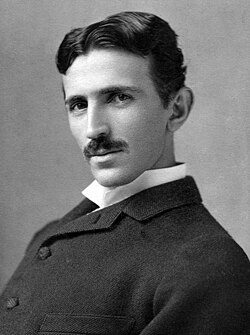
Image from Wikipedia
Author: Napoleon Sarony | License: Public domain
Biography
Nikola Tesla was born on July 10, 1856, in Smiljan in the Austrian Empire (now Croatia).
He discovered static electricity at a very young age while playing with the family cat. From 1870 to 1873, he studied at the high school in Karlovac and became fascinated by his physics teacher's demonstrations.
In 1875, Tesla enrolled at the Technical University of Graz in the physics and mathematics departments. In December 1878, he moved to Maribor, where he worked for several months as an assistant engineer before resuming his studies in Prague in 1879.
In 1882, he moved to Paris to work for the Edison General Electric Company. He emigrated to the United States in June 1884, where he worked for several months with Thomas Edison. In 1885, he founded his first company, Tesla Electric Light & Manufacturing.
At the end of 1886, Nikola Tesla joined forces with Alfred S. Brown and Charles F. Peck, who founded the Tesla Electric Company with him in 1887 and financed his work in exchange for a share of the profits. Tesla developed his alternating current induction motor, patented in 1887. Thanks to a public demonstration organized in 1888, this motor attracted the attention of George Westinghouse, who was looking for a reliable alternating current system. Westinghouse then bought Tesla's licenses and offered him a consulting contract. Tesla then worked for a year in Pittsburgh to adapt alternating current for use in streetcars, but encountered technical difficulties and disagreements with the engineers, which ultimately led to the abandonment of his induction motor for this project.
After Tesla demonstrated his induction motor in 1888, Westinghouse acquired a license for the patent, but fierce competition between electrical companies—Westinghouse, Edison, and Thomson-Houston—slowed its development. The situation worsened in 1890 with the financial panic caused by the near-bankruptcy of Barings Bank, which put Westinghouse in difficulty and led its creditors to demand reductions, particularly in the costly royalties owed to Tesla. As Tesla's motor was still difficult to operate, Westinghouse struggled to justify these expenses. In 1891, faced with the risk of losing control of his company, Westinghouse asked Tesla to waive his royalties, which the inventor agreed to do. Six years later, as part of an agreement with General Electric, Westinghouse permanently bought Tesla's patent for $216,000.
Tesla, who had become financially independent thanks to his patents, worked in several New York laboratories where he further developed Hertz's discoveries, invented the Tesla coil, and conducted pioneering research on high frequencies and wireless lighting, while actively promoting his work. naturalized as an American citizen in 1891 and involved in the American Institute of Electrical Engineers, he watched Westinghouse develop and promote his polyphase system until the 1893 World's Fair in Chicago, where his spectacular demonstrations of wireless electricity and induction motors captivated the public and marked a major milestone in the adoption of alternating current.
In 1895, Tesla founded the Nikola Tesla Company to develop his inventions, but struggled to attract investors. Then his laboratory was destroyed by fire, wiping out years of work and plunging him into deep distress. He rebuilt a new laboratory where he conducted pioneering research on X-rays before abandoning this field in the face of competition. He then devoted himself to radio control, developing an innovative remote-controlled boat that aroused both fascination and skepticism in the scientific world.
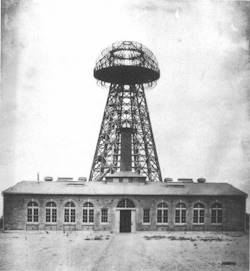
Public domain, via Wikimedia Commons
Between 1890 and 1906, Nikola Tesla devoted his time and fortune to developing a wireless electrical power transmission system, convinced that radio waves were not sufficient for his ambitions. In 1899, he set up a large laboratory in Colorado Springs, where he experimented with giant coils producing voltages of several million volts and mistakenly believed that he could use the entire Earth as a conductor of electricity. He also detected mysterious signals that he interpreted as potentially extraterrestrial. Despite significant media coverage, Tesla struggled to provide solid evidence and then turned his attention to the construction of a major facility: the Wardenclyffe Tower, financed in part by J.P. Morgan in 1901. When Marconi succeeded in making the first transatlantic radio transmission, investors turned away from Tesla; severely short of funds, he was unable to complete his tower, which never became operational, leading to the definitive abandonment of the project and the mortgaging of the site to cover his debts.
After the failure of Wardenclyffe, Tesla continued to search in vain for funding and opened several offices in New York, but his financial situation deteriorated to the point of bankruptcy. Nevertheless, he continued his work, notably on his bladeless turbine, which found no industrial application, and was involved in several legal cases related to wireless communication patents. During his final years, isolated and modestly supported by Westinghouse, he filed one last patent in 1928, suffered a serious accident in 1937 from which he never fully recovered, and died in poverty in 1943, leaving behind more than 300 patents and a reputation as a visionary but marginalized genius.
In 1960, the name Tesla (T) was given to the international unit of magnetic induction.
Awards & Honors
- National Inventors Hall of Fame (1975)
- doctor honoris causa from the University of Paris (1937)
- Grand cross of the Order of the White Lion (1936)
- John Scott Award (1934)
- Edison Medal (1916)
- Elliott Cresson Medal (1894)
- IEEE Fellow
- Knight Grand Cross of the Order of the White Eagle
- Knight Grand Cross of the Order of Saint Sava
- Honorary doctor of the University of Zagreb
- Fellow of the American Association for the Advancement of Science
- Honorary doctor of the Technical University of Graz
- Order of St. Sava
- Order of the White Eagle
- Order of the Crown
- Order of Prince Danilo I
- Order of the White Lion
Books About Nikola Tesla
Wizard: The Life and Times of Nikola Tesla: Biography of a Genius by Marc Seifer (2016) - View on Amazon
Museums & Memorials
Nikola Tesla Museum: Krunska 51, Belgrade, Serbia. Visit website
📍 Birthplace Location
Born on this day
Loading...