
Leonardo da Vinci
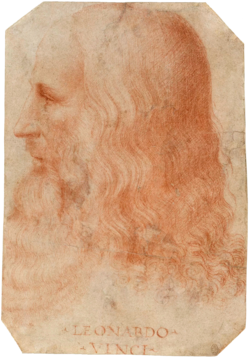
Image from Wikipedia
Author: Attributed to Francesco Melzi | License: Public domain
Biography
Introduction
Leonardo da Vinci (1452–1519) was an iconic Italian Renaissance polymath - celebrated worldwide as a painter, inventor, scientist, engineer, anatomist, and thinker. His unparalleled curiosity and genius created some of the most influential artworks and visionary technical designs of all time. Today he remains a global symbol of creativity and interdisciplinary achievement.
Early Life & Background
Leonardo da Vinci was born on 15 April 1452 in Vinci, a small town in the Republic of Florence (modern-day Italy).
He was the illegitimate son of Ser Piero da Vinci, a notary, and Caterina di Meo Lippi, a peasant woman. Although his parents did not marry, Leonardo spent his early years living with his father’s family in Vinci, where his uncle’s love of nature influenced his observational skills.
Leonardo received only basic formal education, learning reading, writing, and math, but showed early artistic promise that would define his life.
Artistic Apprenticeship in Florence
At around age 14, Leonardo began a long apprenticeship with Andrea del Verrocchio in Florence, where he learned painting, sculpting, metalworking, carpentry, and technical drawing.
He joined the Guild of Saint Luke in Florence in 1472 but continued working with Verrocchio until establishing his own workshop in 1478.
Florence & Early Works
During his early career, Leonardo received several commissions, including a sketch for the Adoration of the Magi around 1481, although he left it unfinished when he moved to Milan the following year.
These early projects established his reputation as an innovative artist with a deep fascination for light, anatomy, and landscape.
Milan: Court Artist and Engineer
In 1482, Leonardo relocated to Milan under the patronage of Ludovico Sforza, where he served not only as a painter but also as a military engineer, architect, and designer of court festivals.
He worked on an ambitious equestrian statue honoring the Sforza family — a project that was never completed due to war and the repurposing of bronze for cannons.
Major Artistic Masterpieces
The Last Supper
Painted between about 1495 and 1498 in Milan, The Last Supper is Leonardo’s most famous mural. It depicts Jesus’ final meal with his apostles, notable for its psychological depth and expressiveness of each figure.
Mona Lisa
Perhaps the world’s most famous painting, the Mona Lisa was begun in 1503 or 1504. Leonardo’s use of the sfumato technique - subtle gradations of light and color - contributes to the painting’s mystique and lifelike presence.
Vitruvian Man
Drawn around 1490, this iconic study of human proportions reflects Leonardo’s interest in anatomy and geometry, symbolizing the harmony between art and science.
Inventor & Scientist
Leonardo’s notebooks contain sketches for machines and studies across anatomy, physics, mechanics, and flight, revealing his wide-ranging intellectual interests. Among these sketches, notable designs are:
- Flying machines: Leonardo sketched concepts resembling a helicopter and ornithopter.
- Military machines: his designs included an armored fighting vehicle or proto-tank.
- Engineering concepts: bridges, water systems, and mechanical devices are found throughout his codices.
While few of these inventions were built in his lifetime, many working models have since proven the basic soundness of his concepts.
Later Years & Death
Leonardo spent the final years of his life in France under the patronage of King Francis I, who admired him greatly. He continued to work on his scientific research, engineering projects, and artistic studies, although he completed few large paintings during this period. Leonardo Da Vinci died on 2 May 1519 in Amboise, France, leaving behind a vast legacy of art, science, engineering, and philosophical inquiry.
References
Notable Works
A horseman fighting a dragon
Wreath of Laurel, Palm, and Juniper with a Scroll inscribed Virtutem Forma Decorat [reverse]
Allegory on the Fidelity of the Lizard (recto); Design for a Stage Setting (verso)
Codex Atlanticus (F0026)
Codex Atlanticus (F0089)
Codex Atlanticus (F0133)
Codex Atlanticus (F0139)
Codex Atlanticus (F0149)
Codex Atlanticus (F0157)
Codex Atlanticus (F0812)
Codex Atlanticus (F0845)
Codex Atlanticus (F0965)
Codex Atlanticus (F1069)
Codex Atlanticus (F1070)
Copy of the Leonardo Da Vinci's Last Supper
Drapery Study for a Seated Figure
Studies for a Madonna with a Cat
Studies of an Old Man and a Youth (Salai?) in Profile, Facing each Other
Drawing by Leonardo da Vinci (Uffizi, 424 E)
Drawing by Leonardo da Vinci (Uffizi, 425 E)
Drawing by Leonardo da Vinci (Uffizi, 428 E)
Perspective Study for the Background of the Adoration of the Magi
Drawing of Two Heads in Profile and Studies of Machines
Study for the Virgin and Child with St Anne
Sketches for the Last Supper, and other studies
Studies of The Virgin and Child with Saint Anne and Saint John the Baptist
Design for a Scythed Chariot and Armoured Car (?)
studies for the London Virgin of the Rocks
Drapery Study for the Right Arm of St Peter in the Last Supper
Study of Clasped Hands (Hands of St John)
Study for the Last Supper (Judas)
Study for the Last Supper (St Bartholomew)
Study for the Last Supper (St James the Elder) and Architectural Sketches
Study for the Last Supper (St Philip)
Sketch of a Virgin and Child with a Bowl of Fruit
Books About Leonardo da Vinci
Leonardo da Vinci by Walter Isaacson (2018) - View on Amazon
Museums & Memorials
Leonardo da Vinci Museum: Via Roma 68, Vinci, Italy. Visit website
Leonardo3 – The World of Leonardo: Galleria Vittorio Emanuele II, Piazza della Scala, Milan, Italy. Visit website
Le Clos Lucé (Château du Clos Lucé): 3 Rue du Clos Lucé, 37400 Amboise, France. Visit website
Frequently Asked Questions
Did Leonardo da Vinci have children?
No, Leonardo da Vinci never married and there are no reliable historical records that he had any children. He spent his life focused on his art, studies, and scientific work, and formed close relationships with his pupils instead of a family of his own.
Source: Discovering da Vinci
Where are Leonardo da Vinci paintings?
Leonardo’s paintings are spread across several major museums.
- The Mona Lisa is in the Louvre Museum in Paris.
- The Last Supper remains on the wall of the Santa Maria delle Grazie convent in Milan, Italy.
- Saint John the Baptist and The Virgin and Child with Saint Anne are also in the Louvre.
Many other works are in collections including the Uffizi Gallery (Florence), National Gallery (London), and other major institutions.
Source: Britannica
Where are Leonardo da Vinci notebooks?
Leonardo’s notebooks are not in one place but are held in several institutions:
- The Codex Atlanticus is in the Biblioteca Ambrosiana in Milan.
- Various other codices and manuscript pages are in the Royal Collection at Windsor Castle, the British Museum (Arundel - Manuscript), and the Institut de France in Paris (e.g., the Pariser Manuskripte).
Some individual pages also appear in other museum and library collections worldwide.
Source: Britannica
When did Leonardo da Vinci die?
Leonardo da Vinci died on May 2, 1519, in Cloux (now Clos-Lucé), near Amboise, France, at the age of 67.
Source: Britannica
Why is Leonardo da Vinci buried in France?
Leonardo spent his final years in France under the patronage of King Francis I, who invited him to live and work near the royal court. Because he died in France, he was buried there: originally in the church of Saint-Florentin in Amboise. Although that church was later destroyed, bones believed to be his were reinterred in the Chapel of Saint-Hubert at the Château d’Amboise.
Source: https://nicofranz.art/
📍 Birthplace Location
Born on this day
Loading...