
Julius Caesar
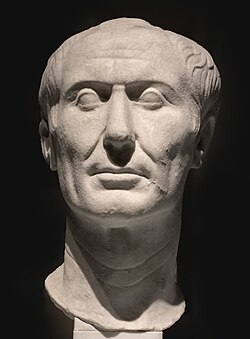
Image from Wikipedia
Author: Ángel M. Felicísimo from Mérida, España | License: Public domain
Biography
Julius Caesar was born on 12 July 100 BCE in Rome, Italy into a patrician family, the gens Julia, which claimed descent from the goddess Venus. From an early age, Caesar was immersed in the political and social life of Rome, receiving a rigorous education in rhetoric, literature, and military strategy. His family had experienced periods of political influence, but during his youth, Rome was marked by internal conflict, social upheaval, and the rise of populist politics, which would shape Caesar’s ambitions.
As a young man, Caesar pursued a political career, initially aligning himself with the populares, a faction that championed the cause of the common people against the traditional aristocratic elite, the optimates. He held various offices, including quaestor in 69 BCE, which provided him administrative experience in the provinces, and later, as aedile, he gained public recognition by sponsoring lavish games and festivals. Caesar’s early military service in Asia and Cilicia also earned him honors and increased his popularity.
Caesar’s private life was marked by strategic marriages and family alliances. He married Cornelia, the daughter of a prominent political figure, which initially caused conflict with the ruling factions. After Cornelia’s death, he married Pompeia and later Calpurnia, using these marriages to consolidate his social and political influence. He was known for his charisma, intellect, and exceptional oratory skills, which made him a formidable figure in Roman politics.
In 60 BCE, Caesar formed the First Triumvirate with Pompey and Crassus, a political alliance that enabled him to secure the consulship in 59 BCE. As consul, he enacted reforms to benefit both the plebeians and his allies. After his term, he was appointed governor of Cisalpine Gaul, Illyricum, and Transalpine Gaul, where he conducted the Gallic Wars from 58 to 50 BCE. These campaigns vastly expanded Roman territory and brought enormous wealth and military prestige to Caesar. His commentaries on these wars, written in Commentarii de Bello Gallico, reveal both his tactical genius and his skillful use of propaganda to bolster his image in Rome.
Tensions between Caesar and the Senate escalated after Crassus’s death and Pompey’s alignment with the Senate. In 49 BCE, Caesar famously crossed the Rubicon River, an act of insurrection that sparked a civil war. He emerged victorious, and in 46 BCE he was appointed dictator, eventually consolidating power as dictator perpetuo. Caesar implemented a wide range of political, economic, and social reforms, including reorganization of the calendar into the Julian calendar, land redistribution for veterans, and debt relief measures.
Despite his reforms and popularity among the people, many senators feared that Caesar’s power threatened the Republic itself. On 15 March 44 BCE, known as the Ides of March, he was assassinated in the Theatre of Pompey by a group of senators led by Brutus and Cassius. His death precipitated another series of civil wars, which ultimately led to the rise of his grandnephew and adopted heir, Octavian (later Augustus), as the first Roman Emperor.
References
Awards & Honors
- Roman triumph
- Consecratio
Notable Works
Commentarii de Bello Civili [Novel]
Commentarii de Bello Gallico [Novel] (-0058)
Frequently Asked Questions
How did Julius Caesar die ?
Julius Caesar was assassinated on 15 March 44 BCE (the Ides of March) when he was stabbed to death by a group of Roman senators during a meeting of the Senate in Rome.
What happened to Brutus after killing Caesar ?
After Caesar’s assassination, Marcus Junius Brutus fled Rome and joined forces with Cassius in the eastern provinces, raising an army against Caesar’s supporters. In 42 BCE, Brutus was defeated by Mark Antony and Octavian at the Battle of Philippi, and he committed suicide rather than be captured.
📍 Birthplace Location
🌍 Also born in Italy (40 total)
Born on this day
Loading...